

An amicable split between OpenAI and Microsoft
The creator of ChatGPT breaks free from commercial exclusivity amid pressure from Anthropic

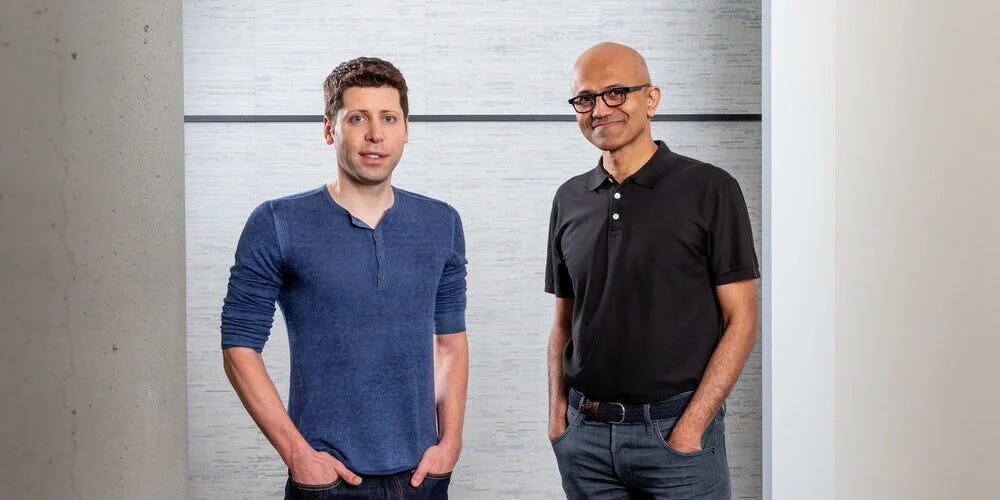
There will be no courtroom showdown between OpenAI and Microsoft. Last week, the two partners formalized a new “long-term” agreement, removing the threat of legal action from the Redmond-based giant. This amicable split notably marks the end of their exclusive relationship — one that had gradually become a drag on the commercial expansion of the creator of ChatGPT, which in recent months has been caught up, and in some areas overtaken, by its main rival Anthropic. Just one day after, OpenAI announced a deal with Amazon to distribute its models on its cloud platform AWS, the global market leader.
In return, Microsoft secured the removal of a clause that would have allowed OpenAI to cut off its access to its technologies once artificial general intelligence, capable of learning any task, was achieved. The company will now retain its license through at least 2032. Another compromise concerns financial terms: Microsoft will still receive 20% of its partner’s revenue, but these payments are now time-limited — through 2030 — and capped. It will also no longer have to pay to offer OpenAI models on its Azure cloud.
A wake-up call for Microsoft
This marks the second time in six months that the two companies have revised the terms of their 2019 agreement — an alliance that had long been mutually beneficial. OpenAI gained the funding ($15 billion in total) and computing power needed to train its large language models. Microsoft, for its part, secured a share of revenue and potentially profits while gaining exclusive distribution of APIs on Azure, a major commercial advantage over AWS and Google Cloud.
The turning point came in November 2023, when OpenAI’s board abruptly dismissed Sam Altman, accusing him of racing too aggressively toward artificial general intelligence while overlooking risks. Although he was quickly reinstated, the episode served as a wake-up call for Microsoft, which realized its risky dependence on the startup. The company subsequently launched a new AI division and declined to invest further in OpenAI, forcing it to seek new funding sources.
End of exclusivity for training
Without much difficulty, the startup raised nearly $50 billion, notably from Japan’s SoftBank. But it also committed to its new investors to abandon its capped-profit status — failing which it would have had to repay those funds. This transformation required Microsoft’s approval. Protracted negotiations fueled growing tensions between the two partners, until a deal was finally reached in late 2025, allowing Microsoft to secure a 27% stake in the new legal entity.
The agreement also introduced initial flexibility for OpenAI, particularly in training and inference. Originally, the company was restricted to Azure servers, a limitation that constrained its ability to scale computing capacity to meet its needs. This exclusivity was partially lifted in 2024, though Microsoft retained veto rights. Freed from this constraint, OpenAI signed a $38 billion, seven-year contract with Amazon the following week.
Responding to Anthropic
Earlier this year, OpenAI deepened its ties with the e-commerce giant, which pledged up to $50 billion in investment, including $15 billion upfront. In return, OpenAI plans to spend an additional $100 billion on AWS and use multiple generations of Trainium chips designed by Amazon. The Seattle-based group also secured exclusive distribution rights for a new platform dedicated to deploying AI agents—a provision that sparked strong objections from Microsoft, which viewed it as violating its exclusivity clauses with OpenAI.
The agreement announced last week puts an end to that potential legal clash. More importantly, it opens the door to new distribution channels — a partnership with Google now appears likely. OpenAI is effectively responding to the rise of Anthropic, currently the only major AI player present across all three cloud giants. The stakes are high, especially as some internal targets have reportedly been missed, according to The Wall Street Journal. So much so that the company’s CFO is said to be concerned about its ability to finance the massive investments required to scale computing power.