

Google challenges Nvidia
The company confirms it used only its TPUs to train Gemini 3 Pro

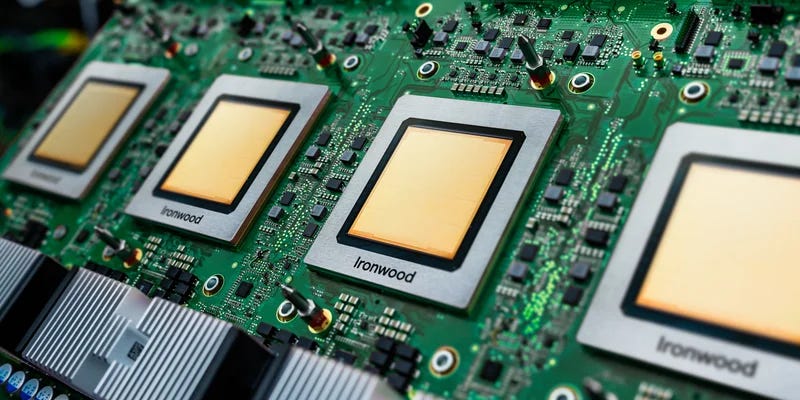
The information is tucked away in technical documentation, but it’s significant. To build Gemini 3 Pro, Google did not rely on Nvidia’s graphics processing units (GPUs), long considered indispensable. The company confirmed to us that its latest generative AI model, unveiled last week, “was fully trained on our custom TPUs.” Likewise, inference — the process of generating responses — “currently” relies solely on these in-house chips.
Earlier versions of Gemini had already been trained on TPUs. But the detail went largely unnoticed. The reason is simple: at the time, those models were seen as far inferior to their rival GPT systems, developed by OpenAI. That is no longer the case. Not only does Gemini 3 Pro outperform GPT-5.1 on various benchmarks, but user feedback has also been highly positive. The same goes for its image generator, Nano Banana, which was also trained on TPUs.
Internal needs
TPUs — Tensor Processing Units — celebrate their tenth anniversary this year. Originally designed by Google to meet internal computing needs tied to the rise of machine learning, they gradually powered a growing number of Google products, from search to YouTube, in the late 2010s. With the boom in generative AI, these chips have been redesigned for the training and inference workloads of new models.
Google does not sell its TPUs, which remain deployed exclusively in its own data centers. Since 2018, the Mountain View company has also made them available to customers of its cloud platform. For a long time, their presence alone served as a selling point against Amazon Web Services and Microsoft Azure, reinforcing Google’s image as a leader in machine learning. But following the arrival of ChatGPT, attention shifted sharply to Nvidia’s GPUs, for which demand has skyrocketed.
Performance approaching Nvidia
Following Google’s lead, other major U.S. tech companies have built their own AI chips: Maia at Microsoft; MTIA at Meta; Inferentia and Trainium at Amazon. OpenAI, for its part, recently partnered with Broadcom — which co-developed the TPUs — to pursue the same path. The main goal is not so much to reduce dependence on Nvidia as to benefit from chips optimized for each company’s internal needs, while directly steering improvements they consider most critical.
In 2022, Google’s TPUs still lagged roughly one generation behind Nvidia’s GPUs. Since then, the company has significantly accelerated development. Over the past three years, it has released three new chips, each delivering major performance gains. On paper, the latest model, Ironwood, offers capabilities comparable to Nvidia’s Blackwell accelerators in terms of compute power and memory. Although Google doesn’t specify it, Gemini 3 Pro was likely trained at least in part on this chip generation.
TPUs for sale soon?
The advancement of TPUs represents a major commercial opportunity for Google Cloud, whose growth already outpaces AWS and Azure. At the end of October, the company announced a partnership with Anthropic, allowing the OpenAI rival to use up to one million TPUs to train its models. According to The Information, Google is also in talks with Meta. The parent company of Facebook, which currently relies on its own infrastructure, is considering renting TPUs as soon as next year.
But Google’s leadership is thinking even bigger, the tech site reports. The company is now seeking to sell TPUs directly. Meta could become one of the first customers, deploying Google’s chips in its data centers starting in 2027. Discussions are reportedly underway with several financial institutions as well. Google believes it could capture 10% of a market currently dominated by Nvidia — a commercial prize worth tens of billions of dollars a year.