

Oracle's revenge
By signing a record contract with OpenAI, the company is finally playing in the big leagues

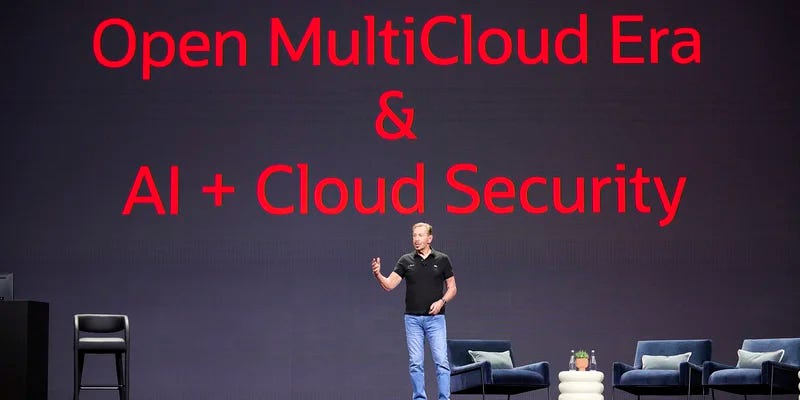
Back in the late 2010s, Marc Benioff loved to remind audiences how he had made Oracle look like yesterday’s news. To the Salesforce CEO, his former employer had become the symbol of aging Silicon Valley firms, too focused on protecting their legacy businesses rather than keeping pace with the market. This narrative hasn’t aged well.
“Complete gibberish”
Last Wednesday, the company founded by Larry Ellison — who briefly became the richest man in the world — enjoyed a landmark day on Wall Street, pushing its market capitalization above $900 billion. It is now reaping the benefits of its pivot to cloud computing, particularly for training and running the latest generative AI models. This shift was rewarded with a record contract, worth $300 billion over five years, signed with OpenAI.
Founded in 1977, Oracle revolutionized database management, following an initial project with the CIA. The company bet early on the potential of the SQL language, leading to rapid success. Over the years, it expanded its offerings with software for planning, financial, and customer relations, largely through acquisitions.
But Oracle did not believe in the potential of the cloud — “It's complete gibberish,” its founder claimed in 2008. That skepticism left the field open to new software publishers like Salesforce and to the big cloud platforms that became the new home for countless databases. Only under Safra Catz, who has been sole CEO since 2019 while Larry Ellison stayed on as CTO, did Oracle finally throw its weight behind cloud infrastructure.
An aggressive strategy to expand capacity
To stand out from well-established rivals, the company embraced a multicloud strategy, letting clients run databases and apps across competitors’ platforms. In 2020, it won a marquee deal with Zoom, the videoconferencing service then riding the pandemic remote-work boom.
A few months later, it leveraged its close ties with the Trump administration to lead the consortium set to buy TikTok’s US operations. This deal was blocked by the courts. But Oracle kept the most important part:a central role in “Project Texas,” hosting US users’ data of the short-video app. Still, it remained a minot player, with just 3% market share, according to Synergy Research.
The rise of generative AI has given Oracle new momentum. Since 2023, it has pursued an aggressive strategy to expand capacity, notably by building a massive data center in Texas. With competitive pricing and strong performance, it has lured clients like Meta, Elon Musk’s xAI, and a range of smaller firms.
A risky bet
But its most promising prospects lie with OpenAI. With Microsoft’s blessing, the ChatGPT maker turned to Oracle for additional compute power, first in a more modest deal last year and now with a $300 billion agreement. The new contract lifts Oracle’s backlog to $455 billion — bigger than those of Microsoft and Amazon. Analysts expect cloud to generate more than half of Oracle’s revenue by 2029.
To meet its commitments to OpenAI starting in 2027, the company will need to accelerate investments in data centers. It will likely need far more than the 4.5 gigawatts of data-center capacity it touted this summer — enough to power a city of four million people. Financing that expansion means taking on substantial debt.
A risky bet: more than two-thirds of Oracle’s backlog now rests on a single client. Its strategy’s financial viability almost entirely hinges on OpenAI’s ability to raise hundreds of billions more. To convince investors, the startup will need to hit ambitious targets, including a projected $200 billion in revenue by 2030.